

Abu Dhabi, Sept. 30, 2026 – Weeks before the Iran war began, Abu Dhabi Crown Prince Sheikh Khaled bin Mohamed Al Nahyan took the helm of a $300 billion sovereign wealth fund.
Now, months into a conflict that’s reshaped the Middle East, this entity and the people running it have become central to building the infrastructure needed to override Iran’s stranglehold over the Strait of Hormuz.
That imperative has come into sharp focus in recent weeks as L’imad Holding announced plans to take the strategically-important Abu Dhabi Ports Co. private at a nearly $9 billion valuation.
People familiar with the matter said the fund is now likely to spend tens of billions of dollars more on new port infrastructure outside the embattled strait. It’s a move that makes the crown prince’s outfit a crucial player in helping develop vital Middle Eastern trade corridors as the emirate pursues a new strategy it calls ‘Zero Hormuz.’
The wealth fund has become a key vehicle for Abu Dhabi’s push to ease its dependence on the waterway that’s been blocked by Iran, people familiar with the matter said, asking not to be named discussing information that isn’t public.
While the son of Abu Dhabi’s ruler and the powerbrokers surrounding him remain little-known globally, they’re now helming one of the world’s largest infrastructure efforts. That makes them crucial to Washington, international commodity markets and Wall Street bosses. Sheikh Khaled, who is in his forties, continues to play a key diplomatic role too, and recently became one of the highest-ranking Arab officials to meet Iranian President Masoud Pezeshkian.
After the Iran war began in February, the crown prince, L’imad’s Chief Executive Officer Jassem Bu Ataba Al Zaabi and other Abu Dhabi officials highlighted their focus on securing national infrastructure during discussions with Wall Street bosses like BlackRock Inc.’s Larry Fink, people familiar with the matter said.
By May, the wealth fund had an agreement with BlackRock, Singapore’s Temasek Holdings and state giant Abu Dhabi National Oil Co. to jointly target up to $30 billion in infrastructure investments for energy transportation, logistics and water. Over time, that could also help the emirate export commodities from oil to petrochemicals and aluminum in the face of an increasingly belligerent Iran.
That deal is an early sign of how Sheikh Khaled’s position as heir apparent in an emirate that wields $2 trillion in sovereign wealth, along with his new push into vital commodities infrastructure, are poised to make him one of the most influential figures in Middle Eastern business and politics in coming years.
The Abu Dhabi royal’s moves to help lower the world’s reliance on Hormuz would bolster US President Donald Trump’s position with Iran and offer new ways for foreign asset managers to eke out profits. But while ensuring the emirate’s commodities make their way around the world has ramifications for global markets, the push is also fraught with risk. Iranian military threats to regional infrastructure remain a concern, and have the potential to upend his multibillion-dollar plans. Transporting commodities longer distances is challenging and the port area where Abu Dhabi is expanding has been previously hit by Iranian projectiles.
Eliminating dependence on the crucial global waterway is a difficult task. Saudi Arabia’s experience highlights the importance of a work-around as well as the risks. Saudi Crown Prince Mohammed bin Salman has pushed to bypass the strait by expanding a pipeline to a port on the Red Sea. Yet the kingdom had to temporarily shut this key alternative to Hormuz in recent weeks after coming under attack from pro-Iran militias.
Abu Dhabi’s crown prince “has a security background and has been given more diplomatic tasks in recent years, so critical infrastructure seems like a natural area for him to take care of,” said Steffen Hertog, a professor at the London School of Economics and Political Science. “The key challenge to my mind is that even the UAE’s eastern ports are close to Iran and within striking range of drones and short-range missiles.”
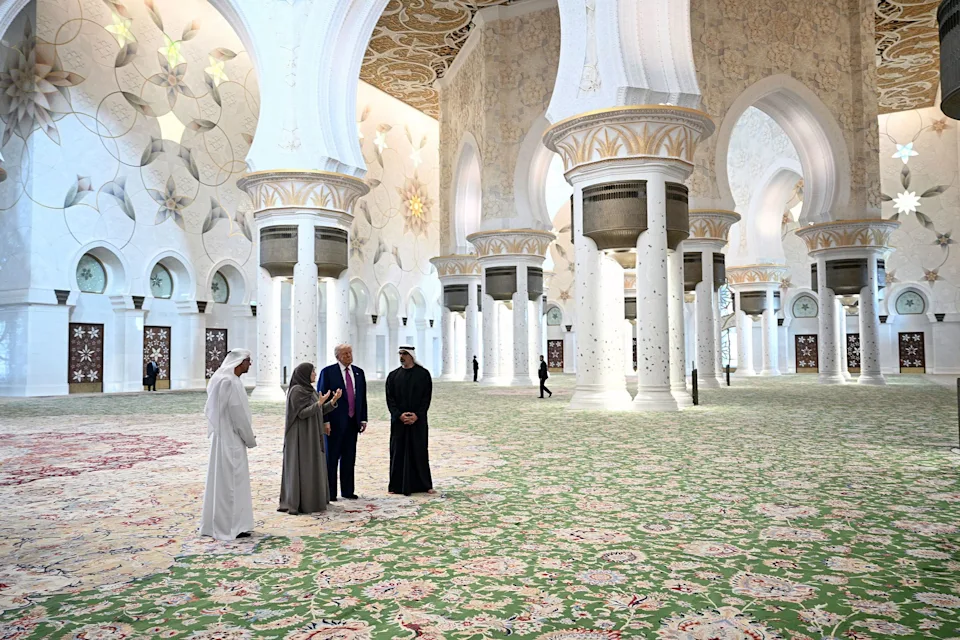
The bearded and soft-spoken Sheikh Khaled is the eldest son of the president of the United Arab Emirates, Sheikh Mohamed bin Zayed. Named crown prince in 2023, he accompanied Trump through Abu Dhabi during a state visit last year and has since taken on a growing role in key diplomatic engagements.
Get the Mideast Money newsletter, a weekly look at the intersection of wealth and power in the region.
At the peak of the war, the younger royal led a high-profile trip to China, one of Iran’s most important trading partners and a key ally of the UAE. A rare public meeting with the Iranian president occurred on the sidelines of the BRICS summit in India and came as Oman sought to bring Gulf nations and the Islamic Republic together to discuss the waterway.
Representatives for Abu Dhabi’s government didn’t respond to requests for comment for this article. A spokesperson for BlackRock declined to comment.
Even before the prince was named chairman of L’imad, the fund had already made waves by joining Paramount Skydance Corp.’s $110 billion winning bid for Warner Bros. Discovery Inc.
Since taking over, Sheikh Khaled has met executives including Citigroup Inc.’s Chief Executive Officer Jane Fraser and Brookfield’s Bruce Flatt. Previously, during the Abu Dhabi Formula 1 race, he was also seen hosting billionaire businessman Todd Boehly and Adebayo Ogunlesi, CEO of Global Infrastructure Partners, the Blackrock unit helming the $30 billion partnership.
The prince shot into greater prominence earlier this year after wealth fund ADQ — that had until then been led by his uncle, Sheikh Tahnoon — was folded into L’imad. In the months since, the enlarged entity has overhauled its executive ranks and reorganized parts of its portfolio to prepare for a more central role in the emirate’s dealmaking ambitions.
The crown prince and the tightly-knit group of Emirati officials who surround him are now likely to be particularly focused on expanding ports in the coastal UAE city of Fujairah, which stands just outside the Strait of Hormuz and opens into the Gulf of Oman, people familiar with the matter said, asking not to be named discussing information that isn’t public.
L’imad’s efforts are just one part of a broader effort across the UAE, where other entities like oil behemoth Adnoc and Dubai’s port giant DP World are also pursuing projects to help bypass Hormuz. The prince is also the chair of the executive committee of the board at Adnoc, which is building a second oil pipeline to double export capacity through Fujairah. At a May meeting, he directed the company to accelerate delivery of the project.
Gulf countries, including the UAE have pushed for more dialogue and diplomacy with Iran. Still, commercial vessels have continued to face attacks from missiles and drones inside and around the Persian Gulf, resulting in extensive damage, deaths and injuries. In a June interview, the UAE’s Minister of Foreign Trade Thani Al Zeyoudi said the country wants to move towards having zero Hormuz dependency regardless if it is open or not.
US Treasury Secretary Scott Bessent has predicted that in two years Hormuz ”will be like a worthless piece of water” because it would be bypassed by oil pipelines. That’s easier said than done. The Iran war has stretched on for months, with no end in sight. Even Qatar’s energy minister has described Bessent’s view as “completely wrong.”
The UAE’s Fujairah has also faced attacks from Iran at the peak of the war. In March, falling debris from an intercepted drone caused a major fire at the oil-trading hub. While the Iranian onslaught on UAE assets appeared to fade in recent months, tensions between the two countries escalated yet again during August as the UAE said it would cut all economic ties with Tehran after accusing Iran of firing ballistic missiles at its territory.
In recent weeks, the Iran-backed Houthis have advanced toward Red Sea coastal areas bordering the strategic Bab el-Mandeb, another strait vital for shipping and energy markets. Meanwhile, the Saudis pivoted back into ramping up sales through Hormuz after attacks from pro-Tehran militias in Iraq forced the shutdown of the East-West pipeline. Since then kingdom has restarted sales through the alternative pipeline.
Eliminating dependency on Hormuz is also likely to be challenging and expensive. While pipelines can help divert oil, moving other commodities like gas or aluminum can be more complex. Still, the UAE has an advantage over nearby Qatar, which has no alternative geographical routes to bypass the strait, and has seen natural gas revenue drop significantly.
In diplomatic meetings, Sheikh Khaled appears acutely aware of the responsibilities he is expected to shoulder, one person familiar with the matter said. He is known to lean heavily on a small group of Emirati officials, some childhood friends and others who have steered Abu Dhabi’s economy for decades.
Spearheading execution at L’imad for the crown prince is Jassem Al Zaabi — nicknamed Abu Dhabi’s ‘Money Man’ by some in the financial industry for his role at the helm of the emirate’s department of finance. Al Zaabi and Saif Saeed Ghobash — who acts as chairman of the crown prince’s office — have been closely involved in discussions around the BlackRock infrastructure partnership, people familiar with the matter said.
Engineering that deal is crucial for the emirate because it didn’t want such a big financial push to be solely funded by state money, the people said. Foreign fund managers like BlackRock have billions to deploy in infrastructure and have vast experience pulling off big projects, minting profits for themselves from the steady cash flow that assets like ports generate. Sheikh Khaled is likely to “rely strongly on experienced advisors at L’imad, several of whom have operated on the highest level within Abu Dhabi for years,” Hertog said.
Despite the backing of global heavyweights, the crown prince and his advisors are navigating new complexities that extend well beyond Iran. Dubai, the UAE’s original business hub, is simultaneously attempting to expand in Fujairah through new container terminals there built by its DP World. That push, along with the Abu Dhabi Ports build out, requires fitting in plenty of new infrastructure in a relatively small area in Fujairah.
Meanwhile, Sheikh Khaled and his aides are one of several influential groups within Abu Dhabi. The prince’s uncles, Sheikh Tahnoon and Sheikh Mansour, still carry enormous heft at home and abroad.
The crown prince is poised to come up against ever deepening regional complexities. His ascent comes as the UAE seeks to balance deepening ties with China and its longstanding security partnership with the US, while managing an increasingly volatile region. American diplomats emphasize that he will have to tread a tight line to ensure a balance between the world’s two largest economies.
According to one former teacher, a young Sheikh Khaled was at ease even in a class of students who went on to become top political scholars in Middle Eastern geopolitics. He’s known to prefer to observe before offering careful interventions.
His rise is already driving changes in Abu Dhabi.
Wall Street bosses and business leaders who once focused on other senior royals like Sheikh Tahnoon when they visited the emirate, now also ensure they have met the crown prince and his main officials, people familiar with the matter said. Sheikh Khaled is expected to continue to seek deals in areas that could help Abu Dhabi bolster its economy and build homegrown champions. Deals like the AD Ports transaction are key even as Iranian threats continue to loom.
“A ‘No Hormuz’ policy is of utmost importance to protect the UAE from further instability in the Strait,” said Sanam Vakil, director of the Middle East and North Africa Programme at Chatham House. Yet “with new ways of warfare and the increasing reach of Iran and its proxy networks, the UAE needs to prepare for infrastructure targeting out of Hormuz as well,” she said (Bloomberg).