

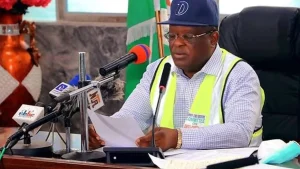
Makurdi, Sept 1, 2026 -The Federal Government has set 2031 as the target for completing key sections of Nigeria’s Trans-Sahara Superhighway, with the project expected to improve connectivity, agricultural logistics, commerce and security across communities in the South-East and North-Central regions.
Minister of Works, David Umahi, disclosed the target during an inspection of ongoing construction on Section Two of the highway in Ado Local Government Area of Benue State.
Umahi said the projects could be completed by 2031, subject to continuity in implementation.
The latest project configuration places Section One at approximately 123 kilometres from Ebonyi State to the Ebonyi-Benue boundary, while Section Two covers about 173.4 kilometres through Benue, Enugu and adjoining areas. Together, the two sections span almost 300 kilometres.
Nearly 300 Kilometres Covered by Two Sections
Section One runs from the Ebonyi axis to the Ebonyi-Benue boundary and is currently designed as a single carriageway. The Federal Government has indicated plans for a second carriageway to align the project with other major infrastructure initiatives.
Section Two extends approximately 173.4 kilometres from the end of Section One through Benue and Enugu towards adjoining states and the Benue River-Nasarawa boundary. The route remains subject to design adjustments as construction progresses.
Umahi said the combined sections would significantly improve access between communities and states along the corridor. The minister also identified the 8.9-kilometre Afikpo bypass in Ebonyi State as part of the infrastructure interventions associated with the corridor. The bypass is currently being dualised.
The minister said the completed road would have a design speed of 100 kilometres per hour, which could substantially reduce journey times along the affected routes.
Government Links Highway to Agriculture and Commerce
The Federal Government expects the highway to strengthen economic activity by improving the movement of agricultural products from major farming communities to markets.
Benue, Ebonyi and Enugu are important agricultural-producing areas, and improved road infrastructure could reduce the logistical difficulties associated with moving farm produce between production centres and major consumption markets.
Umahi said better connectivity would bring communities closer to markets and improve commercial activity across the corridor. He also linked the project to improved security, arguing that better roads would enable security personnel to reach previously isolated communities more efficiently.
The wider Trans-Sahara Highway has a much broader regional significance. The African Development Bank identifies the corridor as a major African integration project connecting Algeria, Tunisia, Mali, Niger, Chad and Nigeria. The bank says the wider Trans-Sahara Highway spans more than 9,000 kilometres and forms part of the continent’s efforts to improve regional trade and connectivity.
Property Impact Becomes Part of Project Planning
The latest inspection also highlighted the impact of highway construction on properties and communities along the alignment.
Umahi directed contractors to minimise unnecessary demolition of houses and other structures. Project officials said design reviews were being undertaken to adjust sections of the alignment and replace selected culverts with bridges where necessary to reduce the impact on private properties.
The minister also appealed to affected communities to cooperate with enumeration and valuation teams involved in the project. He said property owners with valid claims would receive compensation where required.
For the housing and real estate sector, the issue is significant because major transport corridors can alter land-use patterns and property values. Improved accessibility can increase the development potential of previously underserved areas, but infrastructure expansion can also create displacement and compensation challenges where existing settlements fall within road alignments.
Effective planning will therefore remain important as the project progresses, particularly in communities where residential, agricultural and commercial properties intersect with the highway corridor.
Funding Remains a Major Constraint
Despite the 2031 target, the Federal Government acknowledges that funding remains one of the biggest challenges facing the project.
Umahi said the government does not have enough resources to execute all road projects simultaneously, meaning implementation will depend partly on the availability of funds.
The government has previously explored alternative financing for the Trans-Sahara Highway.
In 2024, the Works Ministry opened discussions with the African Development Bank on securing financing for important sections of the Trans-Sahara and Coastal Highways.
The discussions formed part of efforts to mobilise additional resources for major transport infrastructure projects.
The financing question remains particularly important because the Trans-Sahara Highway forms part of a much larger regional transport network. The African Development Bank has described the broader corridor as an important route for regional integration and trade between North, West and Central Africa. (NHM)